
The Real Cost of Owning a Car in Mississauga
Most Mississauga residents know that owning a car is expensive. What they don't know is how expensive — and exactly how much more they're paying compared to drivers in other Ontario cities, simply because of where they live.
The Mississauga Insurance Problem
Let's start with the cost that surprises people most: insurance. For a full postal-code breakdown and quote comparison guide, see our dedicated Car Insurance in Mississauga article.
Mississauga drivers pay roughly $425 more per year than the average Ontario driver, simply because of their postal code. The reasons are largely beyond your individual control:
- High traffic density — Mississauga's major corridors (the 401, 403, QEW, and Highway 410) generate collision claim rates well above provincial averages.
- Auto theft — Mississauga ranked third in Ontario for total auto theft insurance claims at nearly $90 million in costs in 2023, behind only Toronto and Brampton.
- Pearson Airport logistics traffic — the volume of commercial and logistics vehicles around Canada's largest airport increases accident frequency and severity in adjacent postal codes.
Your postal code matters more than you think
Insurance premiums vary sharply within Mississauga itself — a fact many residents don't realize until they move.
That's a gap of $1,200 annually for drivers with identical profiles — driven by proximity to Pearson Airport and elevated theft rates in the L4T area.
Starting July 1, 2026, Ontario is making significant changes to Statutory Accident Benefits (SABS). Many benefits that were previously automatic — including income replacement and caregiver benefits — will become optional add-ons. Any policy issued after that date may appear cheaper at a glance but provide meaningfully less coverage. Speak to your broker before any renewal to ensure you're not inadvertently underinsured — especially if you are self-employed or a contract worker.
Vehicle Cost: Purchase Price & Loan Interest
Before you pay a cent of insurance or fuel, you've already made the biggest commitment: the car itself.
Most Mississauga residents finance their vehicles. On a $34,000 used car financed at 7.5% over 60 months, your monthly payment is approximately $680, totalling $8,160 per year in loan payments — with roughly $6,800 paid in interest alone over the life of the loan.
Mississauga newcomers still building Canadian credit typically face rates of 8.99% to 14.99%. Borrowers in the near-prime range (credit scores of 620–669) pay significantly more. At 12% on that same $34,000 purchase, total interest over five years climbs to over $11,000.
Fuel, Depreciation & Parking
Fuel
Using a conservative estimate of filling a compact sedan's tank weekly at current GTA prices, fuel costs run $320 to $400 per month — roughly $3,840 to $4,800 per year for a typical Mississauga commuter. Drivers of SUVs or trucks pay meaningfully more.
Depreciation: The invisible cost
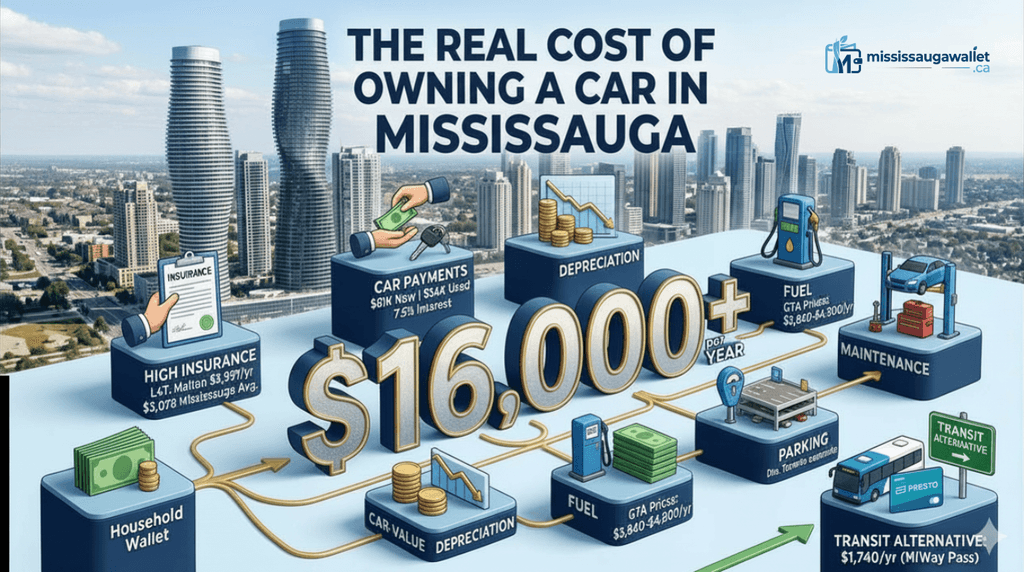
Depreciation is the cost most people don't track — but it's the single largest component of annual car ownership expenses. It accounts for roughly 38% of the average $16,000 annual ownership cost, or approximately $6,080 per year for a typical vehicle. On a $61,000 new vehicle, that's over $12,000 in lost value in year one alone — a cost that appears on no monthly statement but is just as real as your insurance premium.
Parking
A monthly commercial street parking permit in the downtown core costs $218.55 including HST, with additional costs in Port Credit and Streetsville. For Mississauga residents commuting to downtown Toronto, parking costs escalate further: spots in the Financial District can run $25 to $40 per day — up to $11,000 annually for a full-time commuter, on top of everything else.
Maintenance & registration
Annual maintenance costs for a typical vehicle — oil changes, tire rotations, brake service, and the inevitable repair — average approximately $1,500 to $2,500 per year. Mississauga's road salt exposure during winter accelerates undercarriage wear. Ontario vehicle registration renewal adds approximately $120 per year.
The Full Cost Stack
| Cost category | Annual estimate |
|---|---|
| Insurance (Mississauga average) | $3,078 |
| Loan payments (used vehicle, 7.5% over 60 months) | $8,160 |
| Fuel (compact sedan estimate) | $4,200 |
| Depreciation | $6,080 |
| Parking (conservative estimate) | $2,400 |
| Maintenance + registration | $2,000 |
| Total annual cost | ~$16,000–$18,000 |
For two-vehicle households — common in Mississauga's suburban layout — double that figure. You may be looking at $32,000 to $36,000 per year in combined transportation costs before a single grocery run. See how transportation fits into your total household spend with the Mississauga Cost of Living Index.
The Transit Alternative: What the Math Actually Shows
Mississauga is not a city where transit works for everyone. But for residents commuting toward downtown Toronto, Mississauga City Centre, or along the Hurontario corridor, the numbers are striking. Run your own commute through the MiWay vs Driving Regional Cost Calculator to see exactly where transit breaks even for your route.
Affordable Transit Program (ATP): 50% discount on monthly PRESTO passes for eligible low-income residents — $72.50/month. Expanded in April 2026 to include 50% discounts on single fares. Apply through the Peel Region website.
Seniors 65+: MiWay is completely free with a PRESTO card set to the senior fare type — a change implemented July 2025.
Not sure whether a monthly pass or pay-per-ride PRESTO makes more sense for your routine? Read: Is MiWay's Monthly Pass Worth It vs. a PRESTO + GO Combo?
What Mississauga Car Owners Can Do Right Now
- 1
Compare insurance quotes every renewal — without exception
Rates vary by hundreds of dollars between providers for the same driver profile. Rates.ca, Ratehub, and ThinkInsure all offer free side-by-side comparisons. An extra 30 minutes at renewal time can save $300 to $600 annually.
- 2
Ask about usage-based insurance
If you work from home, drive fewer than 12,000 km per year, or have shortened your commute, telematics programs reward low-mileage drivers with 10–25% discounts from several Ontario insurers.
- 3
Install winter tires — not just for safety
Ontario insurers are required to offer discounts for winter tire use. The discount varies by provider but typically runs 2–5% off your premium. At Mississauga's average of $3,078, that's a real saving that partly offsets the cost of the tires themselves.
- 4
Anti-theft devices reduce your premium
Given Mississauga's standing as one of Ontario's highest auto-theft cities, insurers actively price in theft risk. A GPS tracker or certified immobilizer can qualify you for a discount while protecting the vehicle itself.
- 5
Review your accident benefits before July 1, 2026
With Ontario's SABS reform taking effect July 1, any new policy issued after that date will have many formerly automatic benefits turned off by default. Speak to your broker before your renewal — especially for income replacement if you are self-employed or a contract worker.
- 6
Load your PRESTO card for discretionary trips
Even if you can't go car-free, substituting transit for downtown errands, Square One shopping, or evening events reduces your annual mileage — feeding directly into lower insurance rates over time and lowering your monthly fuel bill. See How to Save Money on MiWay & GTA Transit for every discount available.
The Bottom Line
Owning a car in Mississauga in 2026 is a $16,000-per-year commitment at minimum, with insurance costs that are structurally higher than nearly anywhere else in Ontario. Depreciation, loan interest, fuel, and parking compound that figure in ways that rarely show up on a single monthly statement — which is precisely why so many households don't see the full cost until they run the numbers.
The goal isn't to tell Mississauga residents to give up their cars. In a city built around arterial roads and highway interchanges, that advice is simply not realistic for most. The goal is to make the full cost visible — so you can stop leaving money on the table on insurance, make smarter financing decisions, and know exactly when transit pencils out better than driving. While you're auditing your household costs, it's also worth checking where your grocery spending can be trimmed by neighbourhood.
Your wallet deserves the complete picture.