
9 Reasons Mississauga Residents Pay More Than They Should
None of these are scams. They’re defaults — rate plans, assessment dates, fare systems, and fee structures that quietly cost you money until someone tells you they’re optional. Here’s the full list, with the exact fix for each one.
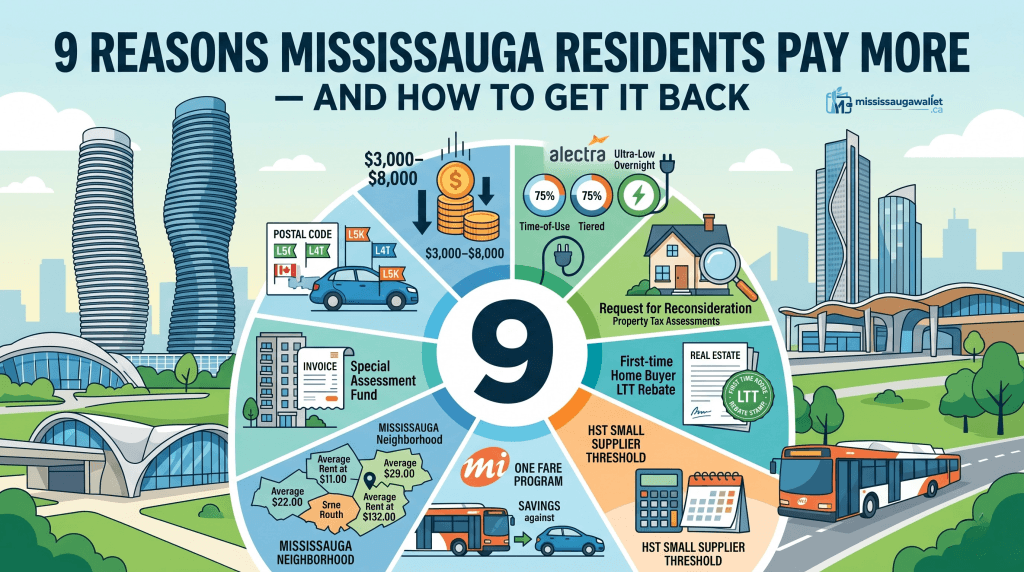
Most Mississauga households and small businesses are leaving money on the table not because of one big mistake, but nine small ones — an electricity plan that doesn’t match their schedule, a property assessment nobody questioned, a rental neighbourhood chosen on vibes instead of math. Individually each one is a rounding error. Added up, they routinely total $3,000–$8,000 a year for a typical household, and more for small business owners. Below is the full audit.
- You’re on the wrong Alectra rate plan
- You’re not claiming the rebate sitting on a frozen 2016 number
- You skipped a $4,000 rebate you were eligible for
- You crossed the HST threshold without noticing
- You’re renting in the wrong neighbourhood for your needs
- You’re driving a commute MiWay would handle for almost nothing
- Your condo fee comparison ignored what’s actually included
- Your car insurance is priced by your postal code
- You’re keeping a car you don’t actually need
You’re on the wrong Alectra rate plan
Mississauga is served by Alectra Utilities, not Toronto Hydro, and Alectra customers can choose between three OEB-approved pricing structures: Time-of-Use (TOU), Tiered, and Ultra-Low Overnight (ULO). The default most households are sitting on is whichever plan they were defaulted into years ago — not the one that matches how they actually use power today.
Why it matters: ULO drops the overnight rate to roughly 3.9¢/kWh — built for households running EV chargers, dishwashers, or laundry after 11 p.m. Tiered pricing rewards flat, moderate daily usage instead. A household that switched to remote work, added an EV, or simply shifted their schedule in the last two years is very likely sitting on the wrong plan for their new pattern, paying TOU on-peak rates (20.3¢/kWh) for usage that could run on ULO overnight rates instead.
Pull your last three Alectra bills and check your hourly usage breakdown against all three rate structures. Households can switch plans once per 12-month period at no cost.
Full Rate Plan Comparison →You’re not claiming the rebate sitting on a frozen 2016 number
Ontario froze MPAC’s province-wide reassessment cycle, so every Mississauga property tax bill in 2026 is still calculated against an assessed value frozen at the January 1, 2016 valuation date — not current market value. A home now selling for $1.2 million in Port Credit may still carry a fixed MPAC assessment of $700,000–$800,000. Because of that freeze, most Mississauga homes are assessed below current market value — which means disputing your assessment to try to lower your bill usually backfires. A Request for Reconsideration invites MPAC to review your file against comparables, and can raise your assessment just as easily as it lowers it. That’s not where the real savings are.
Where the real money is: The City of Mississauga offers an annual property tax rebate — set at $601 for 2026 — for low-income seniors (65+) receiving the Guaranteed Income Supplement, and for low-income persons with disabilities receiving ODSP. It’s a fixed amount, not a maximum, and it’s indexed upward every year in line with the City’s blended residential tax increase. Qualifying also automatically unlocks a stormwater charge subsidy. Both have to be re-applied for every single year by December 31 — there’s no auto-renewal, and the City will not accept a late application for a missed year.
| MPAC Assessed Value | 2026 Annual Increase | Estimated Annual Bill |
|---|---|---|
| $500,000 | +$270 | ~$5,440 |
| $700,000 (city median) | +$377 | ~$7,615 |
| $900,000 | +$485 | ~$9,790 |
If you or your spouse are 65+ and on GIS, or receiving ODSP, apply for the rebate before December 31 — and mark the date to reapply next year. Separately, enrolling in the Pre-Authorized Tax Payment plan removes late-payment penalty interest entirely, regardless of income.
See Your Ward’s Tax Breakdown →You skipped a $4,000 rebate you were eligible for
Buyers moving from Toronto to Mississauga are often pleasantly surprised — and then immediately confused. Toronto charges a municipal land transfer tax on top of Ontario’s provincial tax, effectively doubling the bill. Mississauga buyers pay only the provincial layer, which alone saves most first-time buyers $4,000–$14,000 compared to an equivalent Toronto purchase. On top of that structural advantage, eligible first-time buyers can claim a separate Ontario Land Transfer Tax rebate of up to $4,000 — and it is not automatic. It has to be claimed at closing.
Why it’s missed: The rebate is applied by your real estate lawyer at the time of registration, not by the CRA after the fact. If your lawyer doesn’t ask the right eligibility questions — or you assume “first-time buyer” only applies to brand-new construction — the rebate can simply not get claimed, with no automatic correction afterward.
Confirm explicitly with your lawyer before closing that the first-time buyer LTT rebate has been applied to your Statement of Adjustments — don’t assume it happened by default.
Land Transfer Tax Calculator →You crossed the HST threshold without noticing
Mississauga’s overlap of Pearson Airport logistics work, Highway 401 professional services, and a dense freelance/consulting base means a lot of residents run small businesses without fully tracking their HST exposure. The CRA’s $30,000 threshold isn’t a calendar-year number — it’s a rolling four-consecutive-quarter test, and worldwide revenue counts, including US client billings.
The trap: Many freelancers track annual income against $30,000 and feel safe staying under it within a calendar year — without realizing the rolling four-quarter window can straddle two years and trigger registration earlier than expected. Miss the 29-day registration window after crossing the threshold, and the CRA can assess retroactive HST you should have collected, plus interest compounding daily at 7%, out of your own pocket.
Check your trailing four-quarter revenue total every quarter, not just at year-end. If you bill Ontario businesses primarily, voluntary early registration is often the financially smarter move — it lets you claim input tax credits before you’re forced to.
HST Threshold Checker →You’re renting in the wrong neighbourhood for your needs
Mississauga’s city-wide average rent was $2,300/month on the 14 September 2026 reading, still down year-over-year. That average hides a wide spread, and the extremes keep moving: across the eleven neighbourhoods we rank, readings run from $2,032 in Port Credit to $2,499 in Meadowvale, about $467 a month apart. Over a year, that’s a gap in the thousands, though the like-for-like gap for a given unit size is usually smaller.
Why it persists: Renters frequently search by “Mississauga” generically rather than comparing specific neighbourhoods against their actual commute and lifestyle needs — leaving real savings unclaimed simply because the comparison was never made directly.
Before renewing or signing, compare your target unit type against Cooksville and Lakeview pricing for the same bedroom count. If your commute or lifestyle doesn’t require a premium pocket, the math rarely justifies it right now.
2026 Neighbourhood Rent Rankings →You’re driving a commute MiWay would handle for almost nothing
The Ontario One Fare Program quietly eliminated one of the biggest hidden taxes on GTA commuting: the double-fare penalty for crossing transit systems. A MiWay-to-GO Transit connection now fully rebates your local MiWay fare — you only pay the GO portion. A MiWay-to-TTC, Brampton Transit, Durham, or YRT connection drops the second fare to $0.00 entirely, within a transfer window of 2 hours (starting on MiWay) or 3 hours (starting on GO).
The number that matters: For a typical Cooksville commuter, the monthly cost gap between MiWay-plus-One Fare and driving runs approximately $248/month — over $2,900/year — once gas, parking, and depreciation are factored against a $3.50 PRESTO fare.
Run your specific commute through the calculator below before assuming driving is cheaper. If you qualify for youth, senior, or post-secondary concession fares and haven’t loaded them onto a PRESTO card, you’re also paying the full adult rate unnecessarily.
MiWay vs. Driving Calculator →Your condo fee comparison ignored what’s actually included
Mississauga’s city-wide average condo maintenance fee is roughly $0.67 per square foot per month. Square One’s full-amenity towers run noticeably higher, typically $0.75–$1.10/sq ft. That higher number on its own means nothing — a $900/month fee that includes heat, water, A/C, and parking is often cheaper than a $600/month fee that excludes all four, especially in older buildings with high per-unit utility costs.
The bigger risk: An underfunded reserve fund doesn’t show up in the monthly fee at all — it shows up later as a special assessment. The Condominium Authority of Ontario’s most recent survey put the average special assessment at $3,520 per unit, a cost buyers comparing only the headline fee never see coming.
Always request the full inclusions list before comparing two buildings’ fees side by side, and read the Status Certificate and Reserve Fund Study — not just the listing sheet — before making an offer.
Square One Condo Fee Benchmarks →Your car insurance is priced by your postal code
Two identical drivers with identical vehicles and identical records can pay meaningfully different premiums depending on which side of Mississauga they live on. Proximity to Pearson Airport logistics traffic and elevated auto theft rates push some postal codes well above others.
| Postal Code (FSA) | Area | Approx. Annual Premium |
|---|---|---|
| L5K | Port Credit / Lorne Park | ~$2,737 (cheapest) |
| L4T | Malton | ~$3,937 (most expensive) |
That’s a gap of roughly $1,200 a year for the same driver profile — and Mississauga overall already sits 16% above Ontario’s provincial average premium.
Get quotes from at least three brokers at renewal rather than auto-renewing, and ask specifically how your FSA is being rated. With Ontario’s SABS reform taking effect July 1, 2026, also confirm whether a cheaper-looking renewal quote has quietly dropped optional benefits you actually want.
Car Insurance by Postal Code →You’re keeping a car you don’t actually need
The fully-loaded cost of owning a car in Mississauga — purchase financing, insurance, fuel, maintenance, and depreciation combined — runs approximately $16,000 a year, or over $1,300 a month. For single-car households that occasionally need a second vehicle, and for two-car households where one car mostly handles a commute that One Fare transit could cover, that’s a number worth testing against the alternative before assuming it’s fixed.
This isn’t an argument to give up driving — it’s an argument to actually run the comparison once a year, especially if your commute, work-from-home schedule, or neighbourhood has changed since you last bought a car.
Before your next renewal, lease end, or vehicle purchase decision, compare your real commute cost against MiWay plus One Fare for a full month — not just a single trip.
Full Car Ownership Cost Breakdown →Run Your Own Numbers
Every figure above has a calculator behind it. Plug in your own address, income, and usage to see exactly where you’re overpaying.
Sources: Ontario Energy Board Final Rate Order EB-2025-0055; Alectra Utilities & Toronto Hydro 2026 approved tariffs; Municipal Property Assessment Corporation; City of Mississauga & Region of Peel 2026 Approved Budgets; Canada Revenue Agency HST/GST registration rules; Zumper & Door Insight May 2026 rental data; Condominium Authority of Ontario 2023 Reserve Fund Survey; Ontario auto insurance filings, 2026. Figures are estimates for general guidance and may vary by individual circumstance — confirm specifics with the relevant utility, MPAC, CRA, your lawyer, or your insurance broker before acting.