
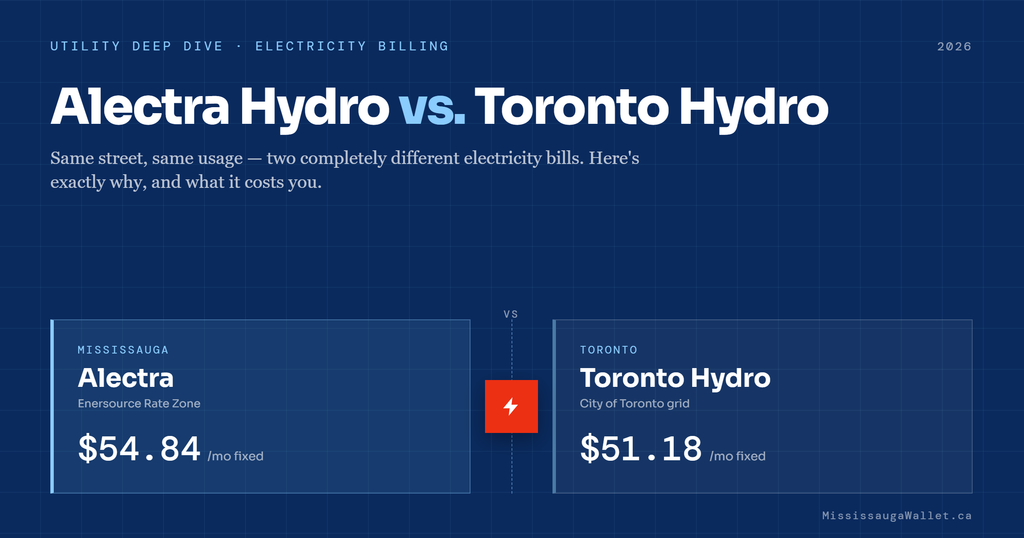
Mississauga is served by Alectra Utilities (Enersource Rate Zone), not Toronto Hydro. Both utilities charge the same provincial electricity commodity rates — but their delivery charges are set independently, and for a typical home using 750 kWh/month, the monthly gap between the two utilities can add up to a meaningful annual difference. Knowing which side of the invisible line you’re on, and understanding why the charges differ, is the first step to managing your bill.
Walk down Bloor Street West near Islington and you’re crossing more than a municipal border. You’re crossing a utility border — one that quietly determines how much electricity costs you every single month. On the Toronto side, your local distributor is Toronto Hydro-Electric System Limited. Cross into Mississauga and it’s Alectra Utilities Corporation, operating what was once called Enersource Hydro Mississauga.
For most residents this distinction is invisible. You flip a switch, the lights come on. But every month when your hydro bill arrives, the difference between these two utilities shows up very concretely in the section labelled “Delivery Charges.” And that gap is not trivial.
The Two-Utility System: How Ontario Electricity Actually Works
To understand why your bill differs from your neighbour across the border, you need to understand how Ontario’s electricity system is structured. There are two fundamentally different components on every Ontario hydro bill.
The first is the electricity commodity cost — what you actually pay for the electrons you use. This is set province-wide by the Ontario Energy Board (OEB) under the Regulated Price Plan (RPP) and is identical for every customer regardless of which utility serves them. Whether you’re in Mississauga or Midland, on-peak is on-peak at the same rate.
The second is the delivery charge — what it costs to move that electricity through the transmission and distribution system to your door. This is where local utilities have complete autonomy. Each utility applies to the OEB for its own distribution rates, based on its own infrastructure, its own capital spending plans, and its own cost base. Alectra and Toronto Hydro file completely separate applications and are approved for completely different delivery charges.
Who Serves Mississauga? A Brief History
Mississauga residents have been on Alectra since January 2017, when four municipal utilities merged: Enersource (Mississauga), Horizon Utilities (Hamilton/St. Catharines), PowerStream (York Region/Barrie), and subsequently Hydro One Brampton. If you still think of your utility as “Enersource,” you’re thinking of Alectra’s Enersource Rate Zone — the legacy territory that covers virtually all of Mississauga.
Alectra is headquartered in Mississauga (2185 Derry Rd W) and is majority owned by the municipalities it serves, including the City of Mississauga, which holds a 26.61% stake — the largest single ownership share of any partner city. In a very real sense, Alectra is Mississauga’s utility.
Toronto Hydro, by contrast, serves only the City of Toronto — roughly 770,000 customers in a far denser urban environment. Its infrastructure challenges are distinct: underground cables, high-density condominiums, and an aging grid built beneath one of Canada’s most congested urban cores.
If you live in Port Credit, Lakeview, or anywhere along the Mississauga–Toronto border, your utility is determined strictly by your municipal address — not by proximity to Toronto infrastructure. A house on the Mississauga side of Etobicoke Creek is on Alectra. Across the creek: Toronto Hydro. There is no blended rate, no partial coverage, no exceptions.
The Numbers: What the 2026 Tariffs Actually Show
Let’s look at the official approved tariffs. Under the Ontario Energy Board’s Final Rate Order EB-2025-0055 effective January 1, 2026, Alectra’s Enersource Rate Zone (Mississauga) residential customers pay a monthly service charge of $54.84 as their fixed delivery component, before any variable distribution charges.
Toronto Hydro’s approved 2026 tariff sets its residential fixed customer charge at $51.18 per 30-day billing period, with additional transmission charges of approximately $0.02241 per kWh on top.
On the surface, Mississauga’s fixed charge is actually higher than Toronto Hydro’s. But the complete picture requires looking at variable distribution charges (per kWh), rate riders, and the overall delivery charge at a typical consumption level — where the relationship can shift.
| Charge Component | Alectra (Mississauga — Enersource RZ) | Toronto Hydro | Notes |
|---|---|---|---|
| Fixed Monthly Service Charge | $54.84/month | $51.18/month | Alectra higher by ~$3.66/mo on fixed component alone |
| TOU On-Peak Rate | 20.3¢/kWh | 20.3¢/kWh | Identical — set by OEB province-wide |
| TOU Mid-Peak Rate | 15.7¢/kWh | 15.7¢/kWh | Identical — set by OEB province-wide |
| TOU Off-Peak Rate | 9.8¢/kWh | 9.8¢/kWh | Identical — set by OEB province-wide |
| ULO Overnight Rate | 3.9¢/kWh | 3.9¢/kWh | Identical — ULO available to both |
| Tiered Rate — Tier 1 | 10.3¢/kWh | 10.3¢/kWh | Identical — set by OEB province-wide |
| Ontario Electricity Rebate | 23.5% | 23.5% | Same rebate — applies to both since Nov 2025 |
| Utility Ownership | Municipal (City of Mississauga 26.61%) | Municipal (City of Toronto 100%) | Both publicly owned |
| Typical Delivery Charge — 750 kWh/month | ~$40–$55/month (all-in delivery) | ~$55–$70/month (all-in delivery incl. transmission riders) | Toronto Hydro’s urban infrastructure costs drive higher variable delivery at moderate-to-high usage |
Sources: OEB Final Rate Order EB-2025-0055 (Alectra, Jan 1 2026); Toronto Hydro Residential Rates page (Jan 2026); Ontario Energy Board RPP rates effective Nov 1, 2025.
Why Are Delivery Charges Different? The Real Reasons
The gap isn’t arbitrary, and it’s not about which city “charges more.” It reflects fundamentally different infrastructure realities.
1. Underground vs. Overhead Infrastructure
Toronto Hydro operates in one of Canada’s most densely built urban environments. A significant portion of its distribution network runs underground — far more expensive to build, maintain, and replace than the combination of overhead and underground lines that serve Mississauga’s suburban-to-urban mix. Underground cable replacement is a major capital cost driver that flows directly into Toronto Hydro’s approved rates.
2. Legacy Infrastructure Age
Toronto’s downtown core has infrastructure that predates modern standards by decades. The cost of renewing aging transformers, cables, and substations in a congested urban environment — often requiring traffic management, permits, and complex coordination — is substantially higher per kilometre than comparable work in Mississauga’s more accessible suburban grid.
3. Customer Density Economics
At first glance, Toronto Hydro’s higher density should mean lower per-customer costs. And in some ways it does — but density also means higher-cost property for substations, more complex streetscape operations, and significant investment in managing peak demand from dense high-rise residential and commercial loads. The economics are not as simple as “more customers = cheaper.”
4. Separate Rate Applications and Approved Cost Bases
Every few years, each utility files a detailed cost-of-service application with the OEB, justifying its proposed distribution rates based on its forecast capital and operating expenditure. These are entirely separate proceedings. The OEB approved Toronto Hydro’s 2025–2029 rate plan in November 2024, and Alectra’s 2026 rates in December 2025 — two completely independent regulatory decisions.
The electricity you use costs the same whether you’re in Mississauga or Etobicoke. What you pay to get it to your door is a different story entirely — and it’s determined by a regulatory process most residents never see.
The November 2025 Rate Shock: What Hit Everyone
One number that did hit all Ontario electricity customers equally was the November 2025 RPP adjustment. On November 1, 2025, the OEB implemented what analysts described as the largest electricity commodity price increase since 2019 — a roughly 29 to 30 percent jump across all rate plans. On-peak TOU moved from approximately 15.7¢/kWh to 20.3¢/kWh. Tiered rates moved from lower thresholds to 10.3¢/12.5¢.
The provincial government responded by raising the Ontario Electricity Rebate from 13.1% to 23.5% — an expanded credit applied directly to bills for residential customers, long-term care homes, farms, and many small businesses. This rebate applies automatically; you do not need to apply. But for a household paying $200/month, the shift in the OER from 13.1% to 23.5% translates to roughly an additional $21/month in savings — partially offsetting the commodity price increases but not eliminating them entirely.
For Mississauga residents, this provincial shift is layered on top of Alectra’s own January 2026 distribution rate adjustments. Alectra’s 2026 rates were adjusted using the OEB-approved inflation-minus-X-factor formula, applying to distribution rates uniformly across all customer classes in all five legacy rate zones.
Rate Plans: Where Mississauga Residents Have Real Choices
While you cannot choose your utility — your distributor is determined by your municipal address — you can choose how your electricity consumption is priced. Both Alectra and Toronto Hydro customers have access to the same three OEB-approved rate plans.
Time-of-Use (TOU) — The Default
TOU is the standard plan for all Regulated Price Plan customers. You pay different rates depending on time of day: on-peak (weekday daytimes, 7am–11am and 5pm–7pm in winter), mid-peak (11am–5pm in winter), and off-peak (evenings, nights, weekends, holidays). If you haven’t switched plans, this is what you’re on.
Tiered Pricing
With tiered pricing, you pay a lower rate for the first block of monthly usage and a higher rate once you exceed the threshold. Thresholds are 600 kWh/month in summer and 1,000 kWh/month in winter for residential customers. For smaller homes using below about 700 kWh/month, tiered can lower total bills compared to TOU.
Ultra-Low Overnight (ULO)
ULO is the game-changer for EV owners and anyone who can shift consumption to overnight hours (11pm–7am). The overnight rate of just 3.9¢/kWh is one of the cheapest electricity prices available anywhere in Canada. The trade-off: on-peak rates under ULO reach 39.1¢/kWh — steep if you can’t shift your daytime usage. For an EV household charging primarily overnight, the annual savings over TOU can reach $300–$600 or more depending on driving habits.
What Mississauga Residents Should Do Right Now
- Check your rate plan: Log into My Alectra at alectrautilities.com. If you haven’t switched, you’re on TOU by default. Run your usage through the OEB’s bill calculator to see if Tiered or ULO would save you money.
- EV or EV-curious? ULO at 3.9¢/kWh overnight is purpose-built for you. Estimate savings at the OEB bill calculator using several months of your actual usage data from My Alectra.
- High winter usage? If your home uses electric heating or your winter bills consistently exceed 1,000 kWh/month, stay on Tiered for the higher winter threshold — you won’t hit Tier 2 as often.
- You can switch at any time: Alectra allows rate plan changes anytime, applied to your next billing statement. There is no penalty and no lock-in.
- Verify the Ontario Electricity Rebate appears on your bill: The 23.5% OER should be visible as a credit line item on bills since November 2025. If it’s not showing, contact Alectra.
- Check Alectra rebate programs: Alectra offers conservation rebates for smart thermostats, insulation, EV charging infrastructure, and commercial energy retrofits (up to 50% on eligible projects). These reduce your consumption — the only lever you control on the commodity portion of your bill.
The Coming Harmonization: What Changes in 2027
Here’s a development that every Mississauga electricity customer should be aware of. Alectra has applied to the OEB for its 2027–2031 distribution rate plan — and one of its central proposals is the harmonization of all five legacy rate zones into a single Alectra-wide rate zone.
If approved, this means the Enersource Rate Zone (Mississauga), Brampton Rate Zone, PowerStream Rate Zone, Horizon Rate Zone, and Guelph Rate Zone would all eventually be charged the same distribution rates. Right now, customers in different Alectra zones pay meaningfully different delivery charges based on the historic cost structures of the predecessor utilities.
Harmonization is a double-edged sword. For Mississauga specifically, whether rates go up or down depends on how Mississauga’s Enersource Rate Zone costs compare to the blended Alectra average. The OEB proceeding is underway; final rates would take effect January 1, 2027. Residents and small businesses can participate in or follow the OEB hearing process at oeb.ca.
The Bottom Line for Mississauga Households
The electricity bill question isn’t really “is Alectra cheaper or more expensive than Toronto Hydro?” — it’s more nuanced than that. At lower monthly usage levels, Alectra’s Enersource zone can run comparably or even slightly lower in total delivery cost. At higher consumption levels, the variable delivery components interact with the fixed charges in ways that differ between the two utilities.
What you can control is your rate plan, your consumption timing, and whether you’re capturing available conservation rebates. What you cannot control is your utility — but you can understand it, and understanding it is the first step to not overpaying.
The invisible line between Mississauga and Toronto means your hydro bill will always look a little different from your Etobicoke neighbour’s. Now you know exactly why.