
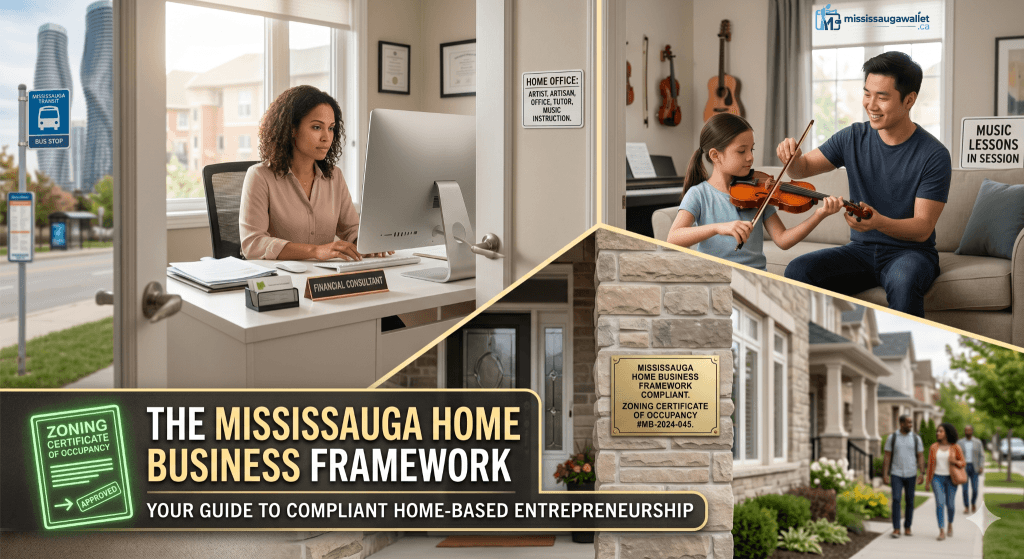
Yes, you can legally run a business from a Mississauga residential property. City Zoning By-law 0225-2007 permits home-based commercial activity as an accessory use in all residential zones, but it restricts your commercial footprint to a maximum of 25% of the dwelling's gross floor area, capped at 50 square metres, whichever is less.
Zero outward-facing commercial modifications are permitted: no retail signage, no dedicated customer entrances, no exterior structural changes that signal commercial use to a passerby. The residential character of the property must remain visually intact.
Mississauga is home to tens of thousands of sole proprietors, freelancers, and side-hustlers operating out of garages, spare bedrooms, and basement offices. What most of them don't know is that the City's zoning framework, the licensing matrix, and the CRA's home-office deduction rules combine into a surprisingly powerful compliance-and-savings toolkit — if you know how to use it.
This guide strips away the legalese and gives you the actual numbers for 2026.
1. The Zoning Fundamentals: What By-law 0225-2007 Actually Says
Mississauga Zoning By-law 0225-2007, in force since June 20, 2007 and regularly amended, treats a business operated from a private dwelling as a "home occupation" — a permitted accessory use in residential zones, provided it doesn't alter the residential character of the property.
To put the square footage limit in practical terms: a 2,000 sq. ft. semi-detached home in Meadowvale can dedicate up to 500 sq. ft. to business use under the 25% rule — but the 50 m² (≈538 sq. ft.) absolute cap means your effective maximum is approximately 500 sq. ft. before you breach the absolute limit. A 1,600 sq. ft. townhome in Streetsville, however, caps out at 400 sq. ft. under the 25% rule, which is the binding constraint.
The by-law also imposes restrictions on: parking (no additional commercial vehicle parking on-site beyond normal residential), nuisance (no noise, odour, or vibration that would be perceptible from neighbouring properties), and prohibited uses (detailed in the licensing matrix below).
- Dedicated home office (spare room or defined area)
- Product storage within the floor-area limit
- Client meetings by appointment (limited)
- Business computer equipment and office furniture
- One non-resident employee working on premises
- Exterior business signs or commercial lighting
- Dedicated customer entrance or retail display
- Auto repair, mechanical work in garage
- Manufacturing or industrial activity
- Commercial vehicles parked visibly on-site
2. The Mississauga Licensing Matrix
Zoning compliance and licensing are separate obligations. You can be within the zoning rules and still require or be exempt from a City of Mississauga business licence, depending on your business type. The City's Licensing, Permits & Regulatory Services office (950 Burnhamthorpe Road West, and online for some categories) administers these.
| Business Category | Mississauga Examples | City Licence Required? | Notes |
|---|---|---|---|
| Digital / RemoteNo client traffic, no physical products delivered from home | E-commerce (shipping from warehouse), freelance consulting, remote bookkeeping, graphic design, virtual assistant | No — As-of-Right | Permitted under zoning without a municipal licence. Federal/provincial registration (HST, business name) may still apply. |
| Mobile ServicesVehicle-based, no fixed-location client attendance | Landscaping, snow removal, mobile pet grooming, driveway sealing, driving instruction | Yes — Mobile Business Licence | Applies in person at 3235 Mavis Rd. (lower floor). Vehicles used operationally must be licenced separately. Certificate of Insurance ($2M minimum for trade-based contractors). |
| TradesSkilled trades operating from residential base | Electricians, plumbers, HVAC installers, building renovators, paving contractors | Yes — Trade Business Licence | Requires Skilled Trades Ontario Certificate of Qualification + $2M liability insurance. Criminal record check required for building renovator and paving contractor applications. |
| Personal Care / AestheticsServices involving human body; esthetics or blood exposure risk | Home hair styling, nail services, aesthetics, tattoo/piercing, permanent makeup | Yes — Personal Services Licence | Strict requirements: Zoning Certificate of Occupancy or building permit required in addition to licence. New licence: $255.21. Renewal: $230.17. Peel Public Health inspection typically required. |
| Tutoring / InstructionIn-home educational or coaching services | Academic tutoring, music lessons, fitness coaching (in-home), language instruction | Varies | In-home tutoring is generally permitted under zoning but check parking impact — multiple student visits per day can trigger by-law enforcement. Group classes (more than 2–3 simultaneous students) may breach the residential character test. |
| Food / Home BakerySmall-scale home food production | Home baker, jam/preserve maker, catering prep from home | Varies | Ontario's Homemade Food Act (2023) permits limited home food sales without a commercial kitchen for many product types. However, City zoning and Peel Public Health rules may still apply. Verify both before operating. |
| Prohibited UsesNot permitted in residential zones regardless of licence | Auto repair in residential garages, vehicle painting, light manufacturing, storage of hazardous materials, boarding kennels with multiple animals | N/A — Zoning Violation | These uses are zoning violations under By-law 0225-2007 irrespective of any licence held. Enforcement is complaint-driven; penalties can include fines and orders to cease. |
If you're unsure whether your business requires a City licence, the City of Mississauga's 311 line (905-615-4311 from outside city limits) can advise. For zoning-specific questions, contact the Planning and Building Department's Zoning Section. Licence applications for most categories require an in-person appointment at 950 Burnhamthorpe Road West — book ahead, as wait times vary.
3. The Home Workspace Tax Deduction: Localized for Mississauga
This is where compliance translates directly into money recovered. As a sole proprietor operating from a Mississauga home, you can deduct a proportional share of your home's operating costs against your business income on CRA Form T2125 (Statement of Business or Professional Activities), Part 7.
The rules are clear on eligibility: your home must be your principal place of business (you do the majority of your work there), or you use the workspace exclusively for business income and meet clients there on a regular basis. For most Mississauga freelancers and consultants, the principal-place test is easily met.
"The deduction cannot create a loss — but any unused portion carries forward indefinitely to future tax years."
The Meadowvale Semi-Detached Case Study
Let's apply this to a real Mississauga scenario: a sole proprietor — say, a freelance project manager — working from a 2,000 sq. ft. semi-detached home in Meadowvale. They've designated a spare bedroom (approximately 200 sq. ft.) as their home office, representing a 10% workspace allocation. They're claiming on the conservative end; many CRA practitioners use square footage divided by total GFA.
But per the article brief, let's model a 15% home-office allocation consistent with a larger dedicated workspace or a mixed use of a home office plus an adjacent storage/meeting room, still well within the 25% zoning maximum.
Based on $700K assessed value × 1.0339% mill rate (2026 confirmed rate)$7,237$1,086
Typical Mississauga household, ~750 kWh/month, tiered pricing + OER rebate, Alectra delivery$1,740$261
Typical Mississauga household, post-carbon-charge elimination (April 2025), 2026 rates$1,400$210
Typical Mississauga semi-detached, annual premium (note: inform insurer of home business use)$1,800$270
Cleaning supplies, minor repairs, general upkeep attributable to the home$800$120
That $1,947 deduction reduces your taxable sole-proprietorship income by the same amount. At Ontario's combined marginal rate for a middle-income sole proprietor (approximately 43.41% on income between $111,733–$150,000, or ~29.65% on income in the $55,000–$100,000 bracket), the actual tax saving in cash terms is:
What CRA Allows — and What It Doesn't
The eligible expenses for the T2125 Part 7 home office deduction are specified by CRA and confirmed in Guide T4002:
- ✓Property taxes — The full annual bill is eligible for proportional deduction. Claim your business-use percentage on Line 9945 of T2125.
- ✓Heat and electricity — Alectra electricity and Enbridge gas bills qualify. Keep annual statements; monthly averages are acceptable if itemized.
- ✓Home insurance — Eligible, but critically: inform your insurer that you operate a business from home. Some policies exclude business activity; failure to disclose can void claims.
- ✓Maintenance and cleaning — General home maintenance costs are eligible. Specific improvements (e.g., a renovation to your home office) may be treated as capital expenditure subject to CCA rules, not a current expense.
- ✓Mortgage interest (not principal) — If you own your home, the interest portion of your mortgage payments is eligible. Principal repayment is not deductible. Caution: claiming mortgage interest can trigger capital gains implications on eventual sale for the business-use portion.
- ✗Mortgage principal — Not deductible. Only the interest component qualifies.
- ✗Capital improvements to the workspace — A renovation to install built-in shelving or upgrade flooring in your office is a capital cost, not a current deduction. Claim via Capital Cost Allowance (CCA), not on Line 9945.
To support a home office claim, maintain:
- A simple floor plan or measurement record showing your workspace square footage vs. total home GFA
- Annual utility statements from Alectra and Enbridge (or monthly bills totalled)
- Your MPAC property tax statement or City of Mississauga tax bill
- Home insurance policy documents
- A consistent calculation method applied year over year (CRA expects consistency)
Self-employed individuals file T2125 — no T2200 required (that form is for employees). Your workspace claim goes in Part 7, Line 9945.
4. Beyond Home Office: Other Mississauga-Specific Deductions
The home office deduction is the anchor, but it's not the only line item available to Mississauga home-based sole proprietors.
Internet & Phone
If you use your home internet connection for business, the business-use percentage of your annual internet bill is deductible as an operating expense (not under the home-office calculation — it's a separate line on T2125). For a typical Mississauga household paying approximately $80–$100/month for internet, a 60% business-use allocation yields a ~$600 annual deduction.
Home Workspace Improvements (Capital Cost Allowance)
A dedicated desk, office chair, or computer purchased for business use is deductible through CCA — Class 8 (20% declining balance) for furniture, Class 50 (55% declining balance) for computer equipment. These are separate from the home-office calculation and can be substantial in your first year of operation.
Vehicle Use
If you use a personal vehicle for business travel — client meetings, supply runs, site visits — you can deduct the business-use proportion of vehicle operating costs (gas, insurance, maintenance, lease payments). Keep a mileage log; CRA expects contemporaneous records.
City Business Licence Fees
If your business type requires a City of Mississauga licence (personal services: $255.21; trades: varies), that licence fee is a fully deductible business operating expense in the year paid.
5. What If You Rent? A Note for Mississauga Tenants
Approximately 40% of Mississauga households are renter-occupied. If you rent your home and operate a business from it, the same zoning and CRA rules apply — but with two additional layers:
Check your lease: Many standard Ontario residential leases prohibit commercial activity. While the zoning by-law permits home-based businesses, your landlord's consent (express or implied) is separate from municipal zoning permission. Operating a business without consent could constitute a lease breach.
CRA treatment: Renters substitute rent for mortgage interest and property taxes. CRA permits renters to deduct a proportional share of rent paid as a home-office expense on T2125. For a Mississauga renter paying $2,400/month ($28,800/year) in a 2-bedroom apartment, a 15% workspace allocation yields a deduction of $4,320 — significantly higher than the homeowner equivalent, given Mississauga rental rates.
If your home-based business generates more than $30,000 in annual revenue from taxable supplies, you are required to register for an HST number regardless of your business structure. This is a federal obligation — the City licence or zoning status does not affect it. MississaugaWallet has a dedicated HST threshold checker tool for sole proprietors.
6. Your 2026 Compliance Action Plan
Measure your designated workspace. Divide by your home's total gross floor area. If the result exceeds 25%, or the space exceeds 50 m², you are outside the permitted home occupation limit under By-law 0225-2007. Reduce the commercial footprint or consult the City's Planning and Building Department.
Cross-reference the licensing matrix above. If your business category requires a City licence, book an appointment at 950 Burnhamthorpe Road West before operating. The licence fee is small; operating without a required licence is an offence and exposes you to fines.
Pull your 2025 property tax bill (MPAC assessed value × 1.0339% mill rate for 2026 planning), Alectra annual statement, and Enbridge annual statement. Apply your workspace percentage. Enter the result on T2125 Part 7, Line 9945. Carry forward any unused amount to the next tax year if it would exceed your net business income.
Contact your home insurance provider and disclose that you operate a business from the property. Request a home-business rider or endorsement if required. Failure to disclose is the single most common error home-based business owners make — and the most costly if a claim is denied.
If you operate under any name other than your own legal name, Ontario's Business Names Act requires registration with the Ontario Business Registry (ServiceOntario). Cost: $60 for five years. A registered business name is also a required document for most City of Mississauga licence applications.