
Cooksville LRT Business Impact: What Hurontario Street Construction Is Actually Costing You
Metrolinx has confirmed there is no compensation fund for lost revenue. Here’s what six years of Hazel McCallion Line construction has actually done to Cooksville’s commercial strip — and the six financial levers still available to business owners while it continues.
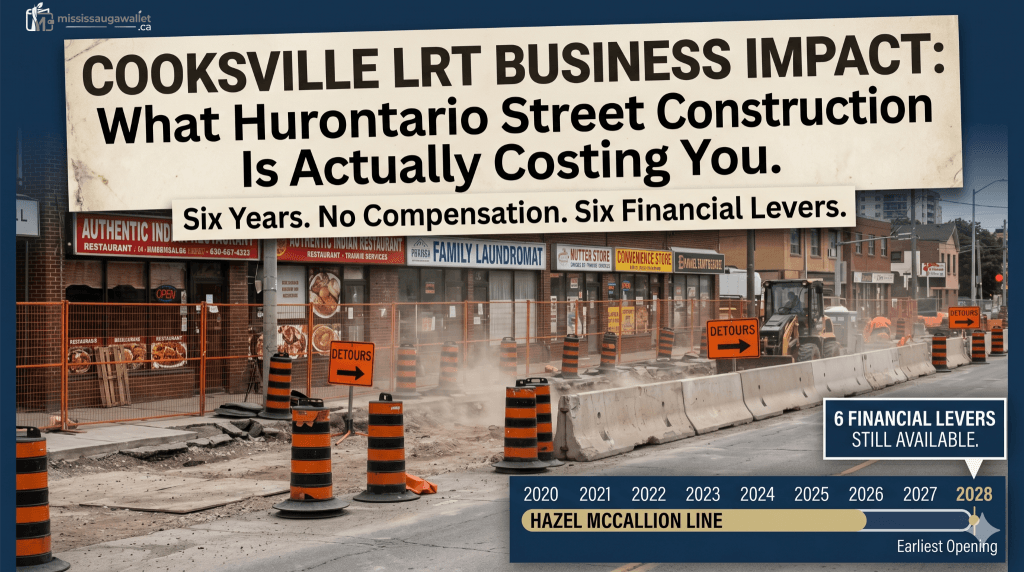
If you operate a business on or near Hurontario Street in Cooksville, Metrolinx will not write you a cheque for construction-related revenue loss — full stop. That position has been confirmed publicly and repeatedly, including in response to a formal bill the Cooksville Business Improvement Area sent the agency after the 2025 Taste of Cooksville festival. The only direct support on offer is non-monetary: BIA marketing programs and local-procurement gestures. Everything else — insurance review, tax-loss timing, HST cash-flow management, and lease renegotiation — is on you, and it’s available right now.
1. Six Years of Construction, No Compensation Mechanism
The Hazel McCallion Line (formerly the Hurontario–Main LRT) is an 18-kilometre light rail line running along Hurontario Street from Port Credit GO Station in the south through Cooksville, Mississauga’s City Centre, and north into Brampton. Construction began in spring 2020. It was originally scheduled to open in fall 2024. As of mid-2026, the project is roughly four years behind that original date, and Mayor Carolyn Parrish has told city council that Metrolinx’s own updated target is 2028 — a date she has said she would not be surprised to see slip further.
Cooksville sits at one of the most disrupted points on the entire corridor: the intersection of Hurontario Street and Dundas Street East, the historic commercial heart of the neighbourhood and the location of the Cooksville GO Station. Businesses here have absorbed six continuous years of lane closures, sidewalk detours, concrete median barriers, and turn restrictions — the kind of day-to-day friction that, multiplied across thousands of customer trips, shows up directly on a small business’s bottom line.
⚠️ Metrolinx’s compensation policy, confirmed: After the Cooksville BIA and the organizers of the annual Taste of Cooksville street festival sent Metrolinx an invoice for construction-related disruption costs following the September 2025 event, the agency’s public response did not include any commitment to pay it. Metrolinx’s stated approach to supporting affected businesses is limited to working with BIAs on shop-local marketing initiatives and procurement from local businesses — not direct financial compensation for lost revenue. This mirrors the position Metrolinx took with businesses along the Eglinton Crosstown LRT corridor in Toronto.
2. The Communication Gap — and Why Businesses Are Left Guessing
One of the most consistent complaints from Cooksville business owners isn’t the construction itself — it’s the lack of warning around it. The Cooksville BIA has stated that after roughly four years of active construction along the corridor, there has not been a single dedicated town hall where business owners could get direct answers on timelines, disruption, and mitigation plans. In February 2026, the BIA noted that Metrolinx had also declined to present at its Annual General Meeting or provide an update on expected 2026 impacts, despite repeated requests for a public forum.
That communication gap showed up concretely in June 2026, when a major partial closure of the Hurontario/Dundas intersection — one of the busiest commercial junctions in Mississauga — was announced to the Cooksville BIA with what the BIA described as only days of notice. Metrolinx told local media it had been sharing high-level details with the BIA since early 2026, but the BIA maintains the final closure notice itself gave businesses and property owners almost no time to prepare for one of the most disruptive traffic events of the entire construction period. For a small business, the difference between a few weeks’ notice and a few days’ notice is the difference between adjusting staffing and signage in advance versus losing sales while scrambling to react.
Compounding the corridor disruption: construction on the redeveloped Mississauga Hospital began nearby in 2025, on the same Hurontario corridor, and is expected to bring a substantial daily increase in construction and delivery vehicle traffic to the Queensway/Hurontario intersection during its peak phase — layering a second major provincial infrastructure project’s disruption on top of the LRT’s.
3. Six Financial Levers Cooksville Business Owners Can Use Right Now
None of these levers replace lost revenue dollar-for-dollar. But used together, they meaningfully reduce the financial damage of operating through a multi-year construction zone — and several of them apply regardless of where you are in Mississauga.
Document losses with a consistent paper trail — starting today
Whether or not a compensation program ever materializes, you cannot make a claim — to an insurer, a landlord, or a future government relief program — without contemporaneous evidence. Keep monthly point-of-sale revenue exports, photograph street-level construction barriers and closures with dates, and retain any written closure notices from Metrolinx or the City. The Cooksville BIA’s own invoice to Metrolinx after the 2025 Taste of Cooksville festival is a model: a documented, dated disruption tied to a specific, quantifiable event.
Review your business interruption and civil authority insurance coverage
Standard commercial property policies often include a “civil authority” clause that can trigger coverage when government action restricts access to your premises — not just when the premises itself is damaged. A construction-related street or sidewalk closure imposed by a public authority may qualify, depending on policy wording and whether access was fully or only partially restricted. Ask your broker specifically about civil authority and ingress/egress clauses; don’t assume your existing policy excludes this without checking.
Use the CRA non-capital loss carryback if construction has pushed you into a loss year
If reduced foot traffic has produced a business loss on your T2125 or corporate return, a non-capital loss can be carried back up to three previous tax years to generate an immediate cash refund of taxes already paid, or carried forward up to 20 years against future income. For a business that was profitable pre-construction and has slipped into a loss during the disruption, the three-year carryback is often the faster path to actual cash in hand.
Track input tax credits on every construction-adaptation expense
Extra signage to redirect customers around closures, temporary delivery/curbside infrastructure, additional security for a longer-than-usual construction perimeter, or marketing spend to counter reduced walk-by traffic — all of these are legitimate business expenses, and the HST paid on them is recoverable as an input tax credit if you’re HST-registered. If construction has pushed your revenue close to or below the $30,000 CRA small-supplier threshold, get specific guidance before deregistering: voluntary registration can still make sense if your input tax credits exceed what you’d collect.
Use the Cooksville BIA’s marketing and shop-local programs — they’re the one thing Metrolinx is funding
Metrolinx has stated its support for affected businesses runs through BIA partnerships: shop-local campaigns, BIA-run promotional events such as Taste of Cooksville, and local procurement commitments. It costs nothing to participate, and it’s the only channel where Metrolinx has actually put resources toward offsetting construction impact. The Cooksville BIA, established in 2020 and representing roughly 145 member businesses along Hurontario and Dundas, runs these programs directly — registering and engaging is the most direct way to capture whatever support does exist.
Revisit your lease for rent relief or renewal leverage
Commercial leases occasionally include force majeure or municipal-disruption clauses that may apply to prolonged government construction blocking customer access — review yours, or have a paralegal/lawyer review it, before assuming there’s no contractual angle. Separately, if your lease is up for renewal during an active construction phase, documented revenue decline is legitimate leverage in rent negotiations: landlords on a multi-year-disrupted corridor have a real incentive to retain a paying, established tenant rather than risk vacancy.
4. Hazel McCallion Line — Cooksville Impact Timeline
Major construction begins along the 18 km Hurontario corridor, including through Cooksville.
Original opening date. Missed — construction delays cited by Metrolinx and contractor Mobilinx.
CBC reporting reveals the province has not provided an updated public completion timeline since 2019, despite the original date having long passed.
Taste of Cooksville festival proceeds despite construction; the Cooksville BIA sends Metrolinx a bill for construction-related disruption costs. No payment commitment follows.
Cooksville BIA publicly states Metrolinx has declined to present at the BIA’s AGM or provide a 2026 impact update, after roughly four years without a single town hall.
Mayor Carolyn Parrish confirms 2028 as Metrolinx’s current internal target for completion, while noting further delay would not surprise her.
Major partial closure of the Hurontario/Dundas intersection begins; the Cooksville BIA says it received final notice with minimal advance warning.
5. The Other Side of the Ledger: What Happens When It Opens
It’s worth being clear-eyed about both directions of this story. Once operational, the Hazel McCallion Line will connect Cooksville GO Station to Port Credit GO, the Mississauga Transitway, Square One, and Brampton Gateway Terminal along a dedicated transit spine with more than 19 stops. The City of Mississauga projects that roughly a quarter of the city’s employment and population growth over the next two decades will concentrate along this corridor — meaning Cooksville’s long-term position, once construction ends, is structurally strong rather than weak.
That’s the trade Cooksville business owners are actually living through: years of acute, uncompensated disruption in exchange for a transit-access upgrade that should increase foot traffic and property values once the line opens. The financial planning challenge isn’t deciding whether to stay — for most established Hurontario Street businesses, the long-term case to stay is solid — it’s surviving the gap between now and 2028 (or later) with as little permanent damage as possible.
📍 Renting or buying commercial space in Cooksville right now? The construction discount on commercial rents and property values may not last. Once a firm opening date is confirmed, expect repricing to begin well before the line actually starts running — similar to what’s already happening in nearby residential pricing along the corridor.
6. Frequently Asked Questions
Does Metrolinx offer any direct cash compensation to Cooksville businesses for lost revenue?
No. Metrolinx’s confirmed position, including in response to the Cooksville BIA’s 2025 invoice, is that it does not maintain a compensation fund for lost business revenue related to LRT construction. Its support is limited to non-monetary BIA marketing partnerships and local procurement.
When will the Hazel McCallion Line actually open?
No firm public date exists. Mayor Carolyn Parrish has cited 2028 as the timeline Metrolinx provided to city officials as of May 2026, while acknowledging further delay is possible. The province has not issued a public, dated completion commitment since before the original fall 2024 target was missed.
Is there a City of Mississauga program specifically for LRT-affected businesses?
The primary local support channel is the Cooksville BIA itself, which runs marketing, beautification, and signature events such as Taste of Cooksville, partly with Metrolinx’s stated cooperation on shop-local promotion. There is no separate City-administered cash relief program specific to LRT construction impact.
Can I deduct construction-related business losses on my taxes?
If construction has pushed your business into a loss for the year, that non-capital loss can be carried back up to three years for a refund of previously paid tax, or forward up to 20 years against future income. Speak with an accountant about which carryback year produces the largest refund given your specific income history.
Use our free calculator to see where you stand for 2026 registration requirements.
Open the HST Threshold Checker →
Sources: The Pointer, “Cursed construction of Hurontario LRT continues to roil residents & businesses; completion date pushed to 2028” (Feb. 10, 2026); INsauga.com, “Residents will get answers on $4.6B LRT construction in Mississauga: Metrolinx” (2026); INsauga.com, “LRT project delays impact Mississauga festival; organizers seek financial compensation” (Sept. 23, 2025); INsauga.com, “LRT project leader not being transparent with community: Mississauga councillor” (Feb. 11, 2026); CBC News, “Mississauga’s LRT was supposed to open last fall. Ontario still won’t say when it’ll be ready” (Aug. 20, 2025); City of Mississauga, Hurontario Light Rail Transit project page; Heritage Mississauga, Business Improvement Areas (Cooksville BIA member count); Cooksville BIA (cooksvillebia.com); Wikipedia, “Hurontario LRT” (corridor/route facts, cross-checked against City of Mississauga and CBC reporting).